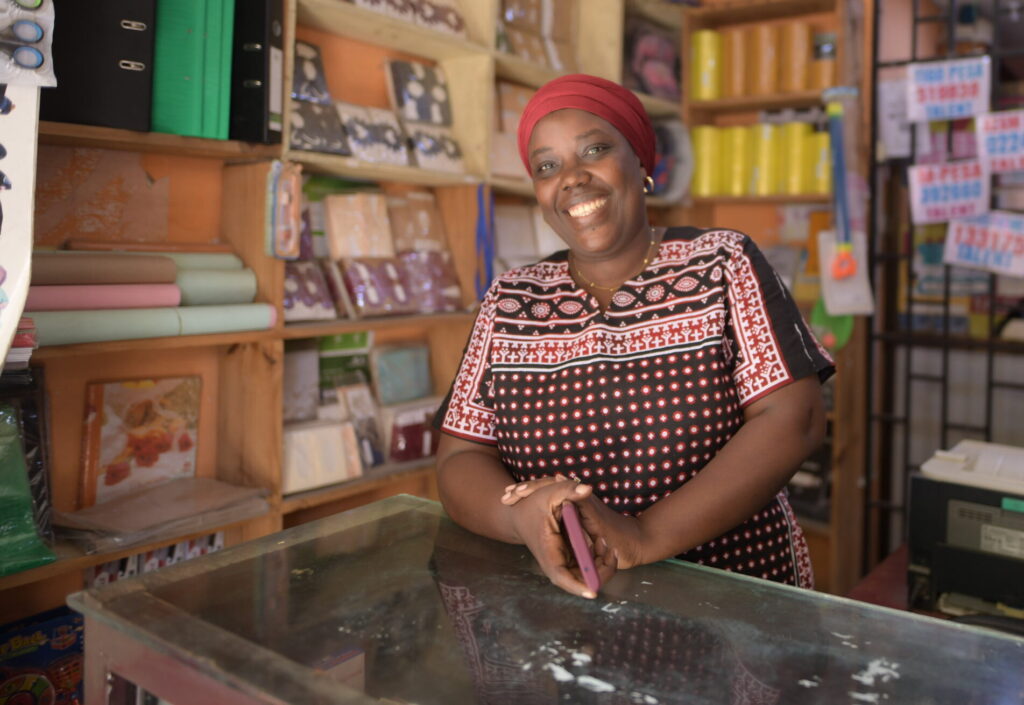
Across Africa, micro, small, and medium-sized enterprises (MSMEs) create jobs, support families, and drive economic activity. Yet many continue to face barriers that limit their growth, especially women-led businesses, which face an estimated $49 billion financing gap.
In Ethiopia, Accion and Jersey Overseas Aid are working with local partners to address this gap and expand access to the tools and support that women entrepreneurs need to grow sustainably and strengthen their financial resilience. Through our partnership with Jemla, we are connecting women retailers to digital commerce and credit opportunities.
Accion Advisory’s Brigitta Mugo, Director of Digital Transformation for the Middle East and Africa, spoke with Jemla co-founder and CEO Estephanos Zewdie to reflect on early insights from a pilot testing an embedded credit product for women retailers and what it takes to scale these solutions more broadly.
How is Jemla supporting small retailers across Ethiopia?
Jemla is a B2B e-commerce platform that helps small retailers that distributors can’t reach access the fast-moving consumer goods they need to run their businesses. We work with manufacturers and importers to source products and provide shop owners with next-day delivery, so they don’t have to spend valuable time and money traveling to wholesale markets, negotiating prices, and arranging transportation.
When you talk to the women merchants on Jemla’s platform, what does a bad week actually look like for them, and how much of that comes down to not having the right credit at the right time?

Think of a major holiday. Everybody’s cooking, so cooking oil would be in high demand. She knows that demand will spike, but she doesn’t have the cash to stock up in advance. She waits to make enough sales to restock, but customers keep coming to her shop looking for products she doesn’t have, so she loses revenue. By the time she has enough cash, chances are, prices have increased, and she’s further behind. And the gap isn’t huge. Maybe $100 or $150 would have made the difference, but because she didn’t have the cash at that time, she lost business. It’s even more challenging if this persists, not just during holiday seasons but anytime products are in high demand.
What inspired you to leverage Jemla’s strong merchant relationships and transactional data to offer credit to women merchants in ways that differ from traditional banks?
We started operations a few years ago and tracked purchasing patterns, basket sizes, product categories, and merchant growth over time. That gave us a much richer picture of a business than a traditional loan application would.
Most banks ask, do you have collateral? Do you have a vehicle or a salary letter? Most small retailers don’t have these assets, but that doesn’t mean they aren’t creditworthy or strong businesses. By looking at what merchants were buying and how consistently they ordered, we could see whether they would be reliable.
The moment it clicked was when we started mapping data with stockouts and purchasing behavior. Instead of asking merchants to find cash elsewhere, we realized that providing credit directly on the platform could help them seize opportunities they would otherwise miss.
Most institutions will say this client segment is too risky. What concerns did you have?
As a startup, capital is very limited, so we had to think about risk and build something different. That’s when we met Accion, which helped us think through how credit products should be structured, what protections mattered, and how to build a responsible offering.
It wasn’t just about funding; it was about bringing lessons from other markets and combining that expertise with our merchant data and customer relationships. Those things together helped us understand and minimize risk.
What response surprised you most, and what assumptions did you challenge with the pilot?
We challenged many assumptions. That’s why we ran a pilot: because we didn’t know all the answers. The goal wasn’t a finished product, but to understand and develop a tailored product for women-owned MSMEs and to test it with real merchants under real market conditions.
Many of these women have been running their businesses for years, and they’re used to certain ways that worked for them despite high inflation and supply chain disruptions. It was a very big ask to try the new credit product. That was the biggest challenge.
We also learned that being in debt carries a stigma because it’s often seen as a burden, the kind of liability that can cause businesses to fail.
And in this dynamic, complex environment, people tend to conserve what they have rather than risk trying something new.
How has that learning influenced your approach?
One is changing the language we use and how we frame things. Instead of talking about “credit,” we say “never run out of stock.” We talk more about the business and less about the financial product.
We’ve had good trials with a few customers, so we’re trying peer advocacy, encouraging those who have used our product to explain it to their peers to drive uptake.
What’s the one thing another platform in Ethiopia, elsewhere in Africa, or around the world can’t skip to be successful in providing credit to women microentrepreneurs?
The relationship aspect. The relationship builds trust, trust builds the transaction, and the transaction helps you leverage the data produced into insights to develop the product. Building a credible relationship with your customer really helps, and the product goes from there.
What still needs to change across the broader ecosystem?
Recognizing these small retailers as businesses worth serving.
On the investment side, building a fintech, especially in developing countries, is very challenging. Having patient investors and efficient capital would be important to do something meaningful for MSMEs.
Are you hopeful that we can achieve those shifts you mentioned? What gives you hope to continue doing this business in challenging times?
Especially this past year, a lot has changed. Data is a new form of collateral that will take us to the next mile. I’m hoping data will be used as an option to see that a business is really creditworthy, that it can survive, that it can thrive.

Get in touch
Contact Accion Advisory
We work to transform the lives of underserved people and small businesses around the world through digitally enabled products and services that improve financial health and resilience. If you share this vision, let us know how we can work together.
Explore More