
As founders, investors, and ecosystem partners gathered to discuss risk management, AI, venture funding, and cross-border payments at this year’s Fintech for Inclusion Global Summit in London, the conversations showed how quickly the landscape is changing for companies innovating and reaching new customers.
Hosted by Accion Ventures with FMO Ventures and the Mastercard Center for Inclusive Growth, the Summit covered some of the most pressing challenges across the industry, as well as how new technologies are reshaping the playing field for startups and incumbents alike.
These discussions at the Summit provided learnings that resonate across the inclusive fintech ecosystem:
1. Innovation and risk management should not be a trade-off.
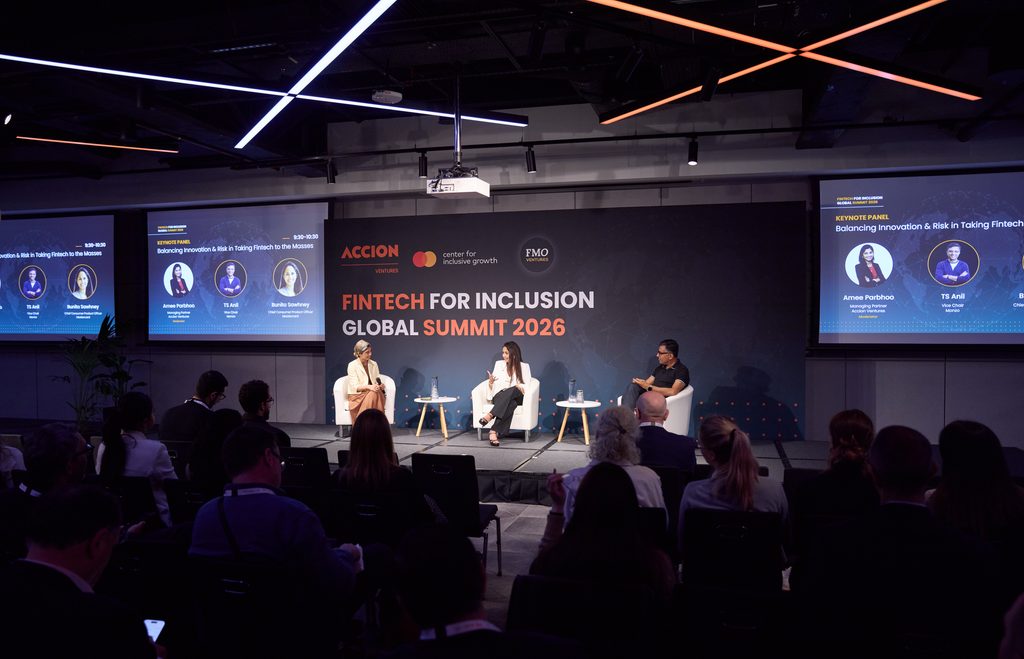
Much risk management in financial services is adding friction: more verification, extra payment steps, slower approvals. It shifts cost to the customer without stopping fraud. Building the control into the product works better. Monzo alerts customers in the app when they are on a call with someone claiming to be the bank. TS Anil of Monzo called innovation versus risk a “false binary,” saying each side should strengthen the other.
The same applies to what gets cut from products for low-income customers. Access has expanded, but many account holders still cannot dispute a transaction or reach a person when something goes wrong. Bunita Sawhney of Mastercard described its Essential Debit product as a lower-cost option that does not compromise the protections consumers need. It keeps chargebacks and dispute rights intact, unlike other low-cost alternatives that offer similar near-instant payment capabilities but don’t offer those important protections.
Accion Ventures backs this kind of design. In India, CareFi works with hospitals on insurance claims and offers a 30-minute discharge after the final bill, so the paperwork falls on the system rather than on patients.
2. The case for AI in inclusive finance is mostly about cost.
AI came up in every session, usually around cost to serve. Serving low-income customers became commercially viable only when the cost of reaching them dropped, and AI lowers it again. Alexia Yannopoulos of Apis Partners said asking whether a company is AI-native today is like asking whether it was internet-native 25 years ago. Most of what Apis sees, she said, is companies using AI to cut cost to serve.
Gangkhar, an Accion Ventures portfolio company, does this in insurance. Its platform lets delivery and mobility apps offer coverage without building an insurance operation in-house, and it uses AI to price and manage risk, which lowers policy costs for consumers. We believe AI matters most where it lowers the cost of reaching customers the industry has found too expensive to serve.
Agentic payments, or purchases made by AI agents on a customer’s behalf, also came up repeatedly. Mastercard has published its work on verifiable intent, a way to confirm an agent is acting on what the customer asked for. Sawhney highlighted Mastercard’s work to help shape these responsible standards, mindful that the pace of development is moving more quickly than regulation.
Ameya Upadhyay of Flourish Ventures expects capital, computing power, and AI talent concentrating in a few places to widen the north-south gap in venture. Flourish is betting that cheap inference and open-weight models will offset it. Investors are also scoring how likely AI is to change a company’s business model and whether its management can adapt.
3. Investors want returns sooner.
On the investor panel, moderated by Pim Engels of FMO Ventures, panelists said limited partners, the investors behind venture funds, ask almost exclusively about distributions to paid-in capital: the cash a fund has returned relative to what investors put in. That focus is changing where capital gets allocated in emerging markets.
Capital is moving to later stages and larger rounds, and early-stage deal volume is down in most markets. The squeeze reaches companies that look healthy on paper. Investors said commercial exits, or sales of an investor’s existing stake, have been difficult in fragmented African markets and that Indonesia remains a tough operating environment. Companies across Latin America, Africa, South Asia, and Southeast Asia work in these conditions every day, which reinforces the case for a diversified, global portfolio.
4. In cross-border payments, the opportunity is shifting.
Matt Oppenheimer of Remitly broke down what makes cross-border payments costly: first collecting and disbursing funds, then treasury and foreign exchange. Digitizing both ends brought prices down over the past decade. Remitly delivers to 170 countries, and more than 90 percent of transfers arrive in under an hour. It is now exploring whether its 25 million customers who receive money could hold funds in a more stable currency before the money is paid out locally.
Eimear Creaven of Mastercard said institutions keep designing products for small businesses when they should be designing around workflows, and that treating small businesses as one category does not work when a gig worker and a mid-sized exporter have almost nothing in common. What these owners need most is time, so the question is what you can take off their plate.
Nika Naghavi of Circle said stablecoins, digital tokens pegged to a currency such as the U.S. dollar, will not replace existing payment systems. The opportunity is to connect the compliance and risk management of the current system to the speed and programmability of the new one: reconciling accounts inside the transaction rather than in a back office days later, and treasury work that once needed a team becoming software.
5. Trust is the deciding factor in adoption.
Oppenheimer said customers may prioritize speed and price, but trust determines whether they finish a transfer once asked for a tax identification number and payment details.
That thinking also drives the Trust by Design Fintech Challenge, run by Accion with support from GRID Impact, which recognizes companies building trust into financial products for women customers in emerging markets. At the Summit, we recognized the winner, Rey Assurance, and finalists: Proto, Corporación Interactuar, and Kaleidofin.
Of course, a single day of networking and panels is not going to change the industry on its own. But the insights shared and the connections made are an important step toward working together across markets to improve access to and adoption of financial services.

Explore More


