Every year around International Women’s Day, we find ourselves asking the same question: what does real progress on women’s financial inclusion look like in practice? At Accion Ventures, we are working to develop an answer through the lens of the companies we invest in and the strategies we help them build to deliver gender-inclusive products.
As we’ve deepened our gender lens approach, examining how gender inclusion can shape company performance at every level of an investment, we’ve found that when early-stage fintechs intentionally design for women, they create social impact and build better businesses. One of our portfolio companies illustrating this is Trukkr, a Pakistan-based logistics fintech pushing the status quo in one of the world’s most gender-constrained economies.
Our gender lens
Women remain massively excluded from formal financial systems despite their economic potential. Of all the micro, small, and medium enterprises (MSMEs) across emerging markets that struggle to access credit, those owned by women face a financing gap of around $1.9 trillion, or 34 percent of the total.
At the same time, women are shown to be more loyal customers and demonstrate better loan repayment than men. A 2024 IFC study found that women-owned MSMEs maintained default rates that were around 0.8 percentage points lower than the broader MSME segment over a five-year period. Importantly, women’s financial inclusion extends beyond customers: According to McKinsey’s Diversity Wins report, companies in the top quartile for gender diversity on executive teams were 25 percent more likely to achieve above-average profitability. Despite this evidence, fintechs often fail to tailor their products to women, and structural barriers like the digital divide and AI-driven bias in credit models continue to exclude women from financial innovation.
Accion Ventures focuses on these opportunities by embedding gender into how we source, evaluate, and support portfolio companies. To measure progress, we align with the 2X Challenge criteria, a globally recognized standard for gender-smart investing, which provides benchmarks for measuring inclusion across the full value chain — from leadership and workforce composition to the customers companies serve. Today, we engage with companies on gender inclusion from due diligence through portfolio governance to measure progress on team demographics, workplace policies, and key customer indicators as they scale. Trukkr illustrates what this approach looks like when a portfolio company fully embraces it in practice.
Trukkr: Building inclusion into the supply chain
Pakistan’s trucking sector is essential to the country’s trade corridors and is overwhelmingly male-dominated. The small business owners, fleet operators, and supply chain participants who keep goods moving across the country have historically had little access to formal credit or insurance. Trukkr is changing that by embedding financial services directly into logistics operations, offering working capital, vehicle financing, and insurance to the businesses and individuals that power this ecosystem.
What makes Trukkr’s story particularly compelling is how deliberately the team has pursued gender inclusion, incorporating it as a core part of product design, workforce culture, and market expansion.
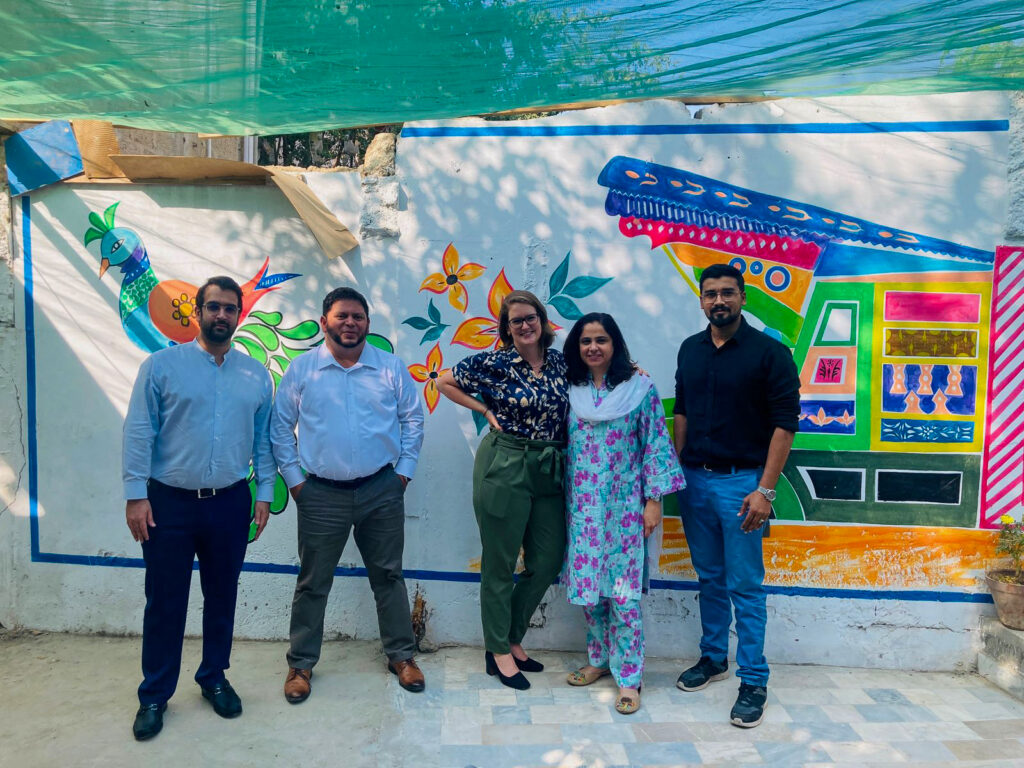
That vision is what helped Trukkr to become the first fintech to receive funding through the Roots of Impact’s Impact-Linked Fund for Gender Inclusive Fintech, a structure that ties non-dilutive financial incentives directly to verified gender outcomes. With technical support from Value for Women, Trukkr developed a “Gender Action Plan” and put it into practice: implementing new workplace policies, measuring organizational culture, and actively recruiting women into the business.
The results were tangible: women on staff grew from 12 to 21 by the end of 2025. Beyond internal representation, Trukkr views women’s participation in the workforce as a critical lever for building trust with underserved women customers, which is essential in markets where women’s interactions with financial institutions are limited.
“The landscape in Pakistan for women lending is almost non-existent. To say that there are barriers for women to borrow is almost an understatement because there’s a huge trust deficit for women to approach financial institutions, because the system hasn’t supported them.”
Sheryar Bawany, Trukkr CEO
On the product side, Trukkr launched EmpowHer, a financial product specifically designed for women-led businesses in the trucking supply chain. To address structural barriers — particularly women’s lower rates of formal asset ownership — Trukkr permits asset collateral in the name of a blood relative. This approach uses a hybrid credit assessment that incorporates behavioral data to reduce thin-file bias and maintains structured feedback loops with women borrowers to continuously refine the product based on customer needs. Trukkr also found that in-person education events and mentorship were critical for converting prospects into active users.
Insights from these feedback loops revealed that flexibility and accessibility mattered more than headline pricing for many women borrowers. As Trukkr observed, “product features such as adaptable repayment schedules, acceptance of collateral in the name of close relatives, and faster approval cycles significantly improved uptake and trust.”
Together, these insights point to a clear customer journey: flexible, women-responsive design helps attract initial interest, while education and engagement build the trust needed for activation. Pricing becomes an important consideration after. Trukkr notes that: “One of the biggest issues was to start building credibility and give women the confidence that they could actually approach a financial institution and receive a commercial loan…We had to do a lot of mentoring and education events and give women the confidence to apply.”
And now that we’re seeing product uptake, demand for EmpowHer has exceeded expectations, and repayment performance among women borrowers has been exceptional, with upwards of a two percent improvement in Trukkr’s repayment performance. Given women borrowers’ historically strong repayment behavior and Trukkr’s innovation-led credit engine, these results are no surprise. Rather, they reinforce what we believe at Accion Ventures: when underserved customers are met with products designed for their needs, they can be remarkably strong performers.
The business case is not a coincidence
It’s tempting to treat gender inclusion as a values question — something companies do because it’s the right thing. But at Accion Ventures, we’ve come to see it as a signal of investment quality.
Companies that intentionally design for underserved women customers are, by definition, doing sophisticated product work. They’re studying their users carefully, removing friction that others ignore, and reaching a segment that most competitors have written off. In fintech, where disciplined customer acquisition costs are paramount and retention is king, this kind of targeted, segment-specific design tends to translate into stronger unit economics over time.
“Gender-intentional design is not a concession. It is a commercial advantage. Supporting gender inclusion has strengthened our product because, as an embedded finance platform, more data leads to better models. [A significant amount of] data was missing because women weren’t applying. Once we prioritized gender inclusion, we began acquiring higher quality borrowers,” says Trukkr CEO Sheryar Bawany.
Across our portfolio — from digital lenders to embedded finance platforms and beyond — companies that serve overlooked customer bases unlock high-value origination channels, improve portfolio quality, and increase retention. We believe that gender-intentional fintech isn’t just a niche, it’s a growth strategy.
“One of our biggest takeaways is how important it is to capture strong gender disaggregated data. We’ve been impressed with how the teams that do this well are able to learn more from their customers and translate that into better products, features, and solutions — and that is fundamental to what we believe is a strong business case.”
Amee Parbhoo, Managing Partner, Accion Ventures
Trukkr is one example of what gender-intentional investing can look like in practice. In the coming months, Accion Ventures will be sharing more of what we’re learning about the companies getting this right, the frameworks helping us measure it, and what it means for the future of inclusive fintech. Our aim is to build a clearer picture of what gender lens investing actually looks like in practice for investors, founders, and the customers whose financial lives depend on getting this right.
Because inclusion, done well, is a competitive advantage.