
Africa’s digital economy is comprised of millions of micro, small, and medium enterprises (MSMEs) using digital solutions to buy inventory, access finance, and reach new customers, many for the first time. However, as digital adoption grows, we see a corresponding increase in cybersecurity risks faced by MSMEs. From phishing scams and fraud schemes to unauthorized data usage, these risks erode customer confidence in digital solutions and hinder further digital adoption. As CGAP warns, “technologies such as automation and extensive data sharing have heightened consumer risks, including fraud and data misuse.”
Security by design is a business imperative
At Accion, we see security not just as a technical feature, but as a core business strategy. We partner with digital platforms to embed trust, privacy, and protection into every layer of the MSME’s digital experience, leveraging data protection as a strategic business function, not just a compliance obligation.
Goodman Mukibi, CEO and founder of Accion partner Merchandise Uganda, shares this view. At his organization, he says, “security by design means that protection of user data, systems, and business processes is intentionally built into the platform at every stage, rather than added as an afterthought.”
Why security matters for small businesses
MSMEs drive local employment, trade, and innovation, yet they are vulnerable to all forms of digital attacks, especially since many are new to digital tools and lack access to updated digital security education.
For them, a cybersecurity breach represents more than a loss of income; it could potentially end their business due to a lack of working capital. The consequences are also dire for platforms, as a breach can destroy hard-earned trust with customers, suppliers, and partners.
Security by design means that protection of user data, systems, and business processes is intentionally built into the platform at every stage, rather than added as an afterthought.
Goodman Mukibi, CEO and Founder, Merchanise Uganda
Accion’s platform partners recognize that merchant protection extends beyond risk mitigation; it unlocks growth.
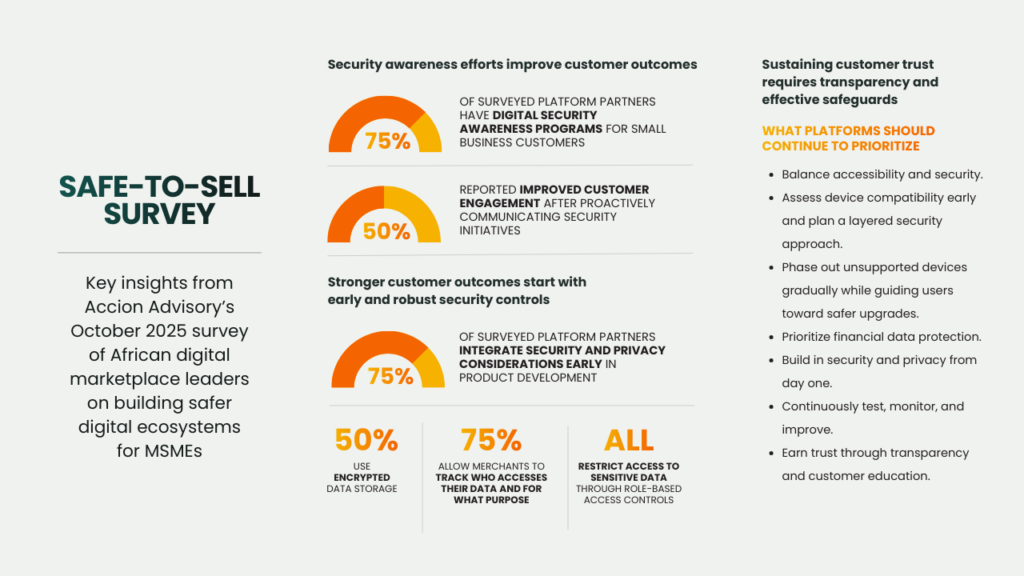
In October 2025, Accion Advisory conducted a “Safe to Sell” survey to gather perspectives from Chief Technology Officers and product leaders across digital marketplace partners we support in Africa. The goal was to better understand their experiences, challenges, and innovative practices — insights that now shape our recommendations for building safer digital ecosystems for MSMEs. Fifty percent of the partners surveyed reported improved customer engagement after communicating their proactive approach to security, underscoring the importance of spotlighting digital safety.
“We have observed increased user adoption, higher trust levels, and improved retention as a result of our privacy and security measures,” noted Goodman.
By implementing approaches such as security-by-design and privacy-by-default, and by emphasizing collaboration through end-user education, we recognize that prioritizing data security delivers tangible business benefits, including higher user retention, increased service adoption, and stronger engagement.
Designing for security
Historically, platforms have reacted to security breaches by fixing issues only as they happened. Today, proactive design is crucial to ensure security is embedded from the start of product development and updated as technology evolves. This entails anticipating risks, limiting data exposure, and building systems with automatic safeguards for users.
Global frameworks like ISO 27001 and OWASP support this approach. TrustArc reports that 82 percent of global firms measure privacy programs and integrate privacy-by-design early. Our survey shows that 75 percent of our partners do the same, indicating a growing emphasis on security and privacy by African digital platforms.
This approach not only protects merchants but also boosts operational efficiency. Platforms avoid costly incident responses, compliance fixes, and loss of user trust by addressing vulnerabilities early, proving that digital security is not a constraint but a driver for digital adoption.
“We balance innovation and functionality with privacy by integrating it from the design process,” says Kalid Areb, product lead at another platform partner. “This helps us to consider the privacy tradeoffs and design the system accordingly, which is also translated into code and functionality.”
Building transparency and trust
Features like privacy-by-default ensure merchants are not required to opt into certain safety measures, particularly for merchants who may lack digital literacy.
From end-to-end data encryption to consent-driven data sharing, our partners are adopting stronger privacy control features to safeguard merchants’ personal and financial information. While these settings are activated by default to provide a smoother user experience, the platforms ensure transparency by clearly displaying data collection and usage policies and providing opt-out options, with clear explanations of the repercussions for customers.
50 percent of surveyed partner platforms use encrypted data storage, 75 percent allow merchants to track who accesses their data and for what purpose through consent management and limited data collection, and ALL have introduced role-based access systems to ensure only authorized staff can view sensitive information.
Merchant education and shared responsibility
Even the best security measures fail if users lack education. Platforms must educate merchants, especially inexperienced ones, about risks such as messages from unverified sources, fake links, and scam calls. The challenge is greater for platforms operating in rural areas, where merchants often rely on family members or neighbors to manage their online stores when platform field agents are unavailable. In many cases, these merchants also share devices, which increases their exposure to risk.
With Accion’s support, our partners run awareness and capacity-building programs, leveraging a phygital (a blend of physical and digital) approach that combines in-app tutorials, workshops, and training to provide hand-holding and continuous follow-up through field agents to build trust and confidence.
Roadblocks and challenges
Despite the benefits, platforms face hurdles in fully adopting security by design:
- Technology constraints: Older devices, common in rural areas, are unable to support modern security standards.
- Cost pressure: Platforms struggle to allocate sufficient resources to build advanced security solutions.
- Balancing UX and security: Some platforms prioritize quick adoption over advanced safeguards.
These realities indicate that there is more to enabling safer digital ecosystems than technology alone. It requires collaboration, education, and commitment from all stakeholders.
When MSMEs feel safe to sell, they unlock their full potential to innovate and thrive in the digital economy. What matters most is that:
- Security is shared: Building a safer digital ecosystem is a shared responsibility. Developers, platforms, and merchants all play core roles.
- Security must be built in, not slapped on: Proactive design prevents losses. Security by design is a core business strategy.
- Security enables growth: Trust drives adoption and retention.
- Awareness empowers: Educated merchants are safer merchants.
Collectively, these elements create secure and more inclusive digital marketplaces that drive Africa’s economy.
Explore More






What is alternative data?





Get in touch
Contact Accion Advisory
We work to transform the lives of underserved people and small businesses around the world through digitally enabled products and services that improve financial health and resilience. If you share this vision, let us know how we can work together.